
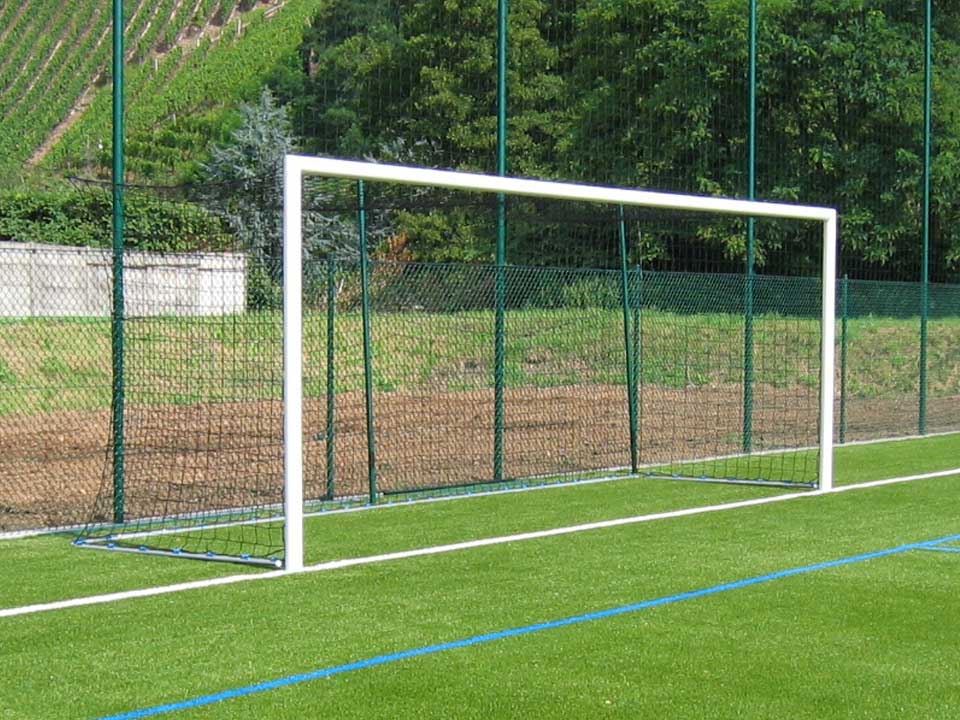
andard football goal post size for an adult 11-a-side match is 7.32 metres wide and 2.44 metres high. These dimensions are set out in Law 1 of the IFAB Laws of the Game and apply to adult men’s and women’s football.
However, goal sizes vary across different formats. Youth football uses smaller goals based on age group and playing format, while futsal has its own regulation dimensions.
For the 2026/27 season, England Football’s FutureFit pathway introduces updated youth football formats and goal-size recommendations. These include 3v3 football for U7 players and different goal sizes for 5v5, 7v7, 9v9 and 11v11 matches.
Knowing the correct dimensions is important when setting up a football ground, buying goalposts or preparing a training facility. This guide covers standard adult goal measurements, youth football goal sizes, futsal dimensions and the main construction and safety requirements.
What Is the Standard Football Goal Post Size?
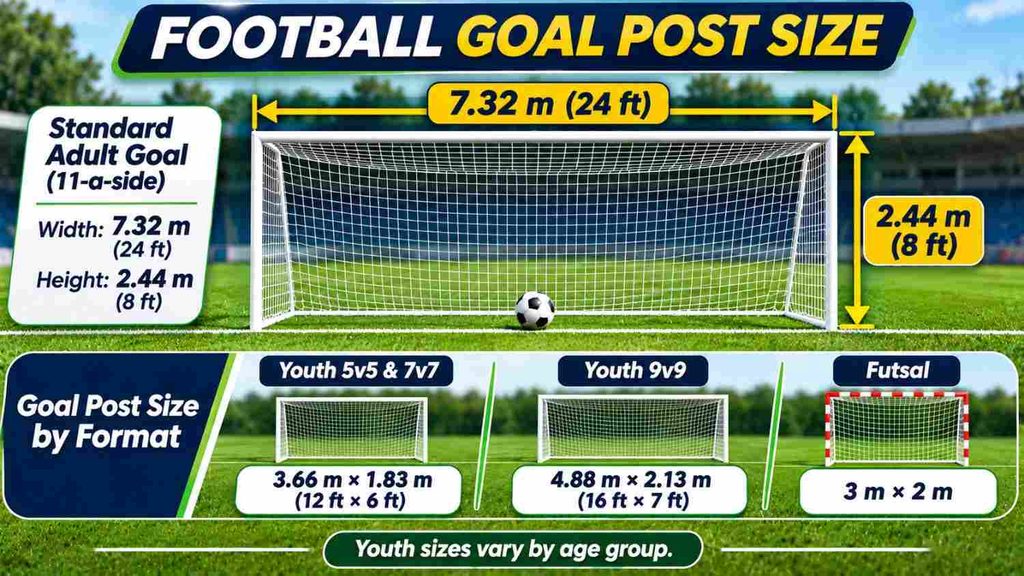
According to Law 1 of the IFAB Laws of the Game, a standard adult football goal measures:
- Width: 7.32 metres or 24 feet
- Height: 2.44 metres or 8 feet
These measurements are the standard for adult 11-a-side association football. The width is measured between the inside edges of the two vertical goalposts. The height is measured from the ground to the lower edge of the crossbar.
A football goal consists of two upright posts connected by a horizontal crossbar. Both posts and the crossbar must have the same width and depth, which cannot exceed 12 centimetres.
The goalposts and crossbar must be white. Both goals used in a match must also have matching shapes. Permitted shapes include square, rectangular, round, elliptical or a combination of these designs.
The same standard dimensions apply to men’s and women’s senior football. The Laws do not prescribe separate goal measurements based on gender.
Football Goal Post Size by Age Group and Format
Goal dimensions vary in youth football because younger players use smaller pitches and different match formats. Appropriate goal sizes help make the game suitable for each age group.
For the 2026/27 season, England Football’s FutureFit pathway provides updated age-group formats and recommended goal sizes.
| Age group | Format | Recommended goal width | Recommended goal height | Metric goal size |
| U7 | 3v3 | 4 ft | 2.5 ft | 1.20 m × 0.75 m* |
| U8 and U9 | 5v5 | 12 ft | 6 ft | 3.66 m × 1.83 m |
| U10 and U11 | 7v7 | 12 ft | 6 ft | 3.66 m × 1.83 m |
| U12 and U13 | 9v9 | 16 ft | 7 ft | 4.88 m × 2.13 m |
| U14 | 11v11 | 21 ft | 7 ft | 6.40 m × 2.13 m |
| U15 and U16 | 11v11 | 24 ft | 8 ft | 7.32 m × 2.44 m |
| U17 and U18 | 11v11 | 24 ft | 8 ft | 7.32 m × 2.44 m |
The FA’s 3v3 guidance lists the recommended U7 goal size as 120 cm × 75 cm. The imperial dimensions are shown alongside it as the corresponding recommended size.
These are England Football recommendations for the relevant age groups. The U17 and U18 recommendation is confirmed separately in England Football’s youth club-football guidance. Other countries and local competitions may follow different arrangements.
U7 Football Goal Size: 3v3
For U7 3v3 football, the recommended goal size is 4 feet wide and 2.5 feet high, or 120 cm × 75 cm.
The separate England Football 3v3 guidance also permits a maximum goal size of 5 feet wide and 3 feet high, or 150 cm × 90 cm. This means the recommended size and the maximum permitted size are not the same.
The smaller goal suits the 3v3 format and the development needs of young players. It provides an appropriate target while helping children develop basic attacking and shooting skills.
5v5 Football Goal Size
The recommended goal size for 5v5 youth football is:
- Width: 12 feet or approximately 3.66 metres
- Height: 6 feet or approximately 1.83 metres
Under England Football’s 2026/27 FutureFit pathway, U8 and U9 players use the 5v5 format.
These goals are smaller than senior football goals and are suitable for younger players and smaller playing areas. However, recreational indoor 5-a-side facilities may use different goal dimensions, depending on their layout and competition rules.
7v7 Football Goal Size
The recommended goal size for 7v7 youth football is also 12 feet wide and 6 feet high. This is approximately 3.66 metres × 1.83 metres.
For the 2026/27 England Football pathway, U10 and U11 players use the 7v7 format.
This format gives young players more space than 5v5 football while keeping the goal manageable for developing goalkeepers. Clubs should follow the relevant age-group and competition requirements when selecting equipment.
9v9 Football Goal Size
For 9v9 youth football, the recommended goal size is:
- Width: 16 feet or approximately 4.88 metres
- Height: 7 feet or approximately 2.13 metres
Under England Football’s 2026/27 pathway, this format applies to U12 and U13 players.
The larger goal suits the bigger playing area and additional players. It also helps prepare young footballers for the transition to full-size 11-a-side football.
11v11 Youth Football Goal Size
The recommended goal size for 11v11 youth football depends on the age group.
Under England Football’s 2026/27 recommendations:
- U14: 21 feet × 7 feet (6.40 m × 2.13 m)
- U15 and U16: 24 feet × 8 feet (7.32 m × 2.44 m)
- U17 and U18: 24 feet × 8 feet (7.32 m × 2.44 m)
For U14 players, the recommended size is 21 feet × 7 feet. Where these goals are unavailable, England Football allows full-size 24 feet × 8 feet goals to be used.
U15 and U16 players move to the full adult goal dimensions under the FutureFit recommendations. England Football’s separate U17/U18 club-football guidance also recommends 24 feet × 8 feet goals for those age groups.
What Is the Futsal Goal Post Size?
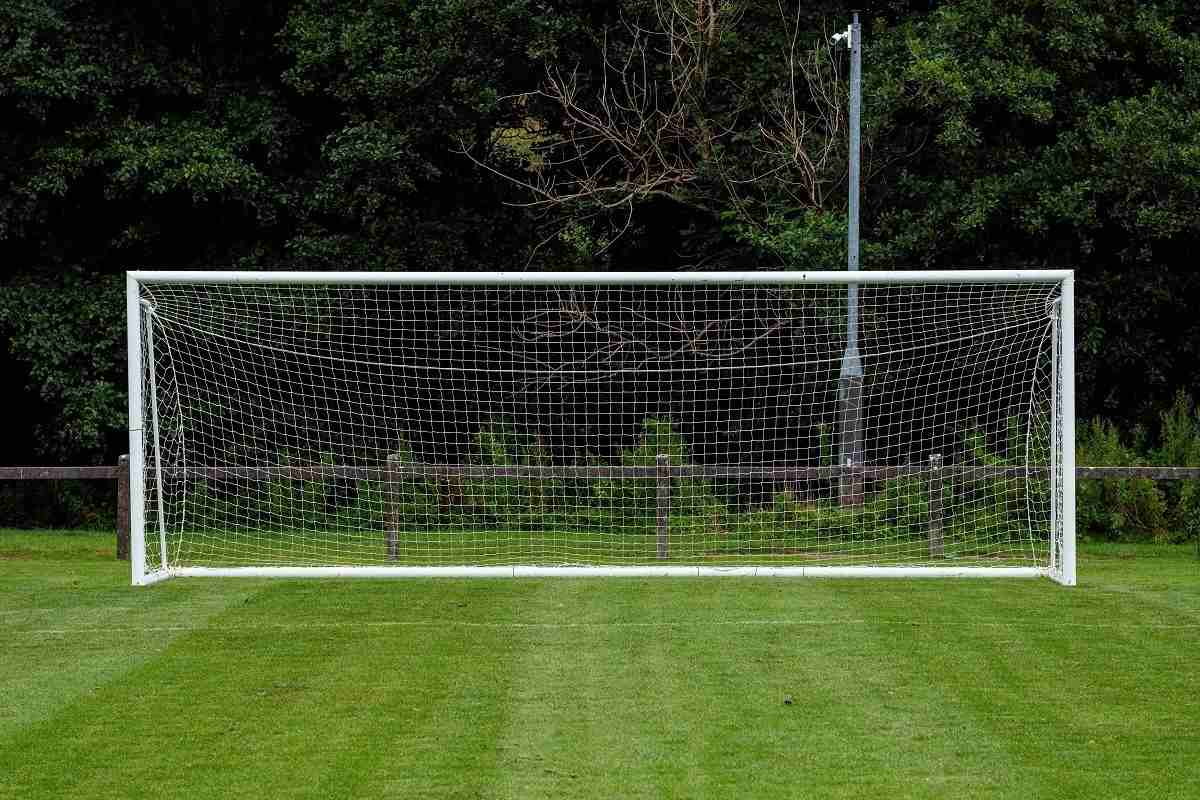
Futsal uses smaller goals than outdoor 11-a-side football. Under the FIFA Futsal Laws of the Game 2026/27, the regulation goal dimensions are:
- Width: 3 metres
- Height: 2 metres
- Post and crossbar thickness: 8 centimetres
The width is measured between the inside edges of the two posts. The height is measured from the floor to the lower edge of the crossbar.
Unlike standard outdoor football goals, futsal goalposts and crossbars must be a different colour from the playing surface. They do not have to follow the white-colour requirement used in association football.
Futsal goals must also have an adequate stabilising system to prevent them from overturning. Wherever possible, they should not be fixed to the floor, as this could create a safety risk. A suitable weight at the rear of the goal is one example of an approved stabilising method. Portable goals must meet the same requirement.
The amendments to the 2026/27 FIFA Futsal Laws came into force on 22 October 2026. The regulation goal dimensions remain 3 metres wide and 2 metres high.
Football Goal Post Rules and Construction
The IFAB Laws of the Game set out requirements for association football goal construction, positioning and safety. These rules help ensure that goals are suitable for competitive matches.
1. Goalpost Shape
The goalposts and crossbar may have a square, rectangular, round, elliptical or approved hybrid shape. Both goals used in a match must have matching shapes.
2. Goalpost Colour
The goalposts and crossbar must be white in standard association football. They must also have the same width and depth.
Futsal has a different colour requirement: its goalposts and crossbar must be a different colour from the court surface.
3. Maximum Thickness
The width and depth of the goalposts and crossbar must not exceed 12 centimetres in standard association football. This is also the maximum permitted width of the goal line.
For futsal, the posts and crossbar must each have a width and depth of 8 centimetres.
4. Goal Net Requirements
Under the IFAB Laws, a net may be attached to the goalposts and crossbar and supported on the ground behind the goal.
It must be properly secured and supported. It must not interfere with the goalkeeper or prevent normal play.
Futsal nets must also be properly supported and must not interfere with the goalkeeper.
5. FIFA Quality Programme for Football Goals
IFAB recommends that goals used in official competitions organised under the authority of FIFA or the confederations meet the requirements of the FIFA Quality Programme for Football Goals.
The programme provides testing standards covering areas such as durability, stability and safety. It helps competition organisers assess whether goal equipment meets the required quality standards.
6. Goal Safety
Under IFAB Law 1, both fixed and portable association football goals must be firmly secured to the ground. A goal that is not properly secured can fall and cause serious injuries.
Clubs, schools and training facilities should regularly inspect goal frames, fixings, nets and supporting structures.
Futsal goals follow a separate safety requirement. They need an adequate stabilising system to prevent overturning and, wherever possible, should not be fixed to the floor.
How to Measure a Football Goal Correctly
Measuring a goal correctly is important when checking its dimensions or ordering replacement equipment. Use the inside measurements rather than measuring from the outside edges.
Follow these steps:
Step 1: Measure the width. Place a measuring tape between the inside edges of the two vertical posts at ground level.
Step 2: Measure the height. Measure vertically from the ground to the underside of the crossbar.
Step 3: Check the frame thickness. Measure the width and depth of the posts and crossbar to confirm that they meet the relevant regulations.
Step 4: Inspect the structure. Check the joints, fixings, net supports and stabilising system. Make sure the goal is properly secured and cannot overturn during play.
For a standard adult 11-a-side association football goal, the inside width should be 7.32 metres and the height should be 2.44 metres.
Football Goalpost Size vs American Football Goalpost Size
The term football goalpost can refer to two different structures.
Association football, commonly called soccer in some countries, uses a rectangular frame with two vertical posts and one crossbar.
American football uses a different structure. Its goalpost has a raised crossbar and two tall uprights. An NFL goalpost has a crossbar measuring 18 feet 6 inches, approximately 5.64 metres, between the uprights. The top of the crossbar is 10 feet above the ground.
These measurements are not interchangeable. If you are buying equipment for association football, use the relevant football goal dimensions rather than American football specifications.
Why Do Football Goal Sizes Vary?
Different football formats use different goal dimensions for several practical reasons.
Player development: Younger players need goals that suit their physical development and playing ability.
Pitch size: Smaller formats use smaller playing areas. Their goals are designed to fit those spaces.
Goalkeeping development: Appropriate goal dimensions help young goalkeepers develop positioning, movement and shot-stopping skills.
Competition regulations: Governing bodies and local leagues set the sizes required for their competitions. A recreational facility may use different dimensions from an official youth league.
Choosing the correct football goal post size helps create a fair and suitable playing environment for everyone.
Conclusion
Choosing the correct football goal post size ensures fair play, safety and proper skill development. A standard adult 11-a-side goal measures 7.32 metres wide and 2.44 metres high. Youth football uses smaller goals based on age and playing format.
For the 2026/27 season, England Football’s FutureFit pathway recommends 4 ft × 2.5 ft goals for U7 3v3, 12 ft × 6 ft for U8–U11, 16 ft × 7 ft for U12–U13 and 21 ft × 7 ft for U14. U15 and older players use the full adult size of 24 ft × 8 ft. U7 3v3 can also use goals up to 5 ft × 3 ft.
Futsal goals have separate dimensions of 3 metres wide and 2 metres high, with 8 cm posts and crossbars.
Always check competition requirements, secure the goal properly and ensure the net is correctly fitted. Choosing the right size helps maintain safety and meet the correct playing standards.
Frequently Asked Questions
The standard adult association football goal measures 7.32 metres wide and 2.44 metres high. This is equivalent to 24 feet × 8 feet and applies to adult 11-a-side football.
A standard adult football goal is 24 feet wide. The measurement is taken between the inside edges of the two goalposts.
The standard adult goal is 8 feet or 2.44 metres high. The measurement runs from the ground to the underside of the crossbar.
A regulation futsal goal measures 3 metres wide and 2 metres high. Its posts and crossbar have a thickness of 8 centimetres. The goal must also have an adequate stabilising system to prevent it from overturning.
Yes. Youth football uses different goal sizes depending on age group and match format. Under England Football’s 2026/27 recommendations, U7 3v3 uses a 4 ft × 2.5 ft goal, U8 and U9 5v5 and U10 and U11 7v7 use 12 ft × 6 ft goals, and U12 and U13 9v9 use 16 ft × 7 ft goals. U14 players use 21 ft × 7 ft goals, while U15 and older groups use the full adult size of 24 ft × 8 ft.
No Responses