
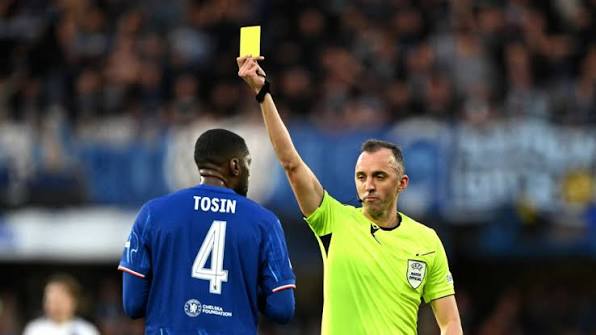
yellow card is one of the most recognisable symbols in football. When a referee raises it during a match, everyone understands that a player has received an official warning. It usually follows an offence such as a reckless challenge, time wasting, arguing with the referee or unsporting behaviour.
However, a yellow card is more than a warning. It becomes part of the player’s disciplinary record and can lead to a suspension if the player collects too many bookings. Two yellow cards in the same match also result in a red card and an immediate dismissal.
Understanding what a yellow card means helps fans follow refereeing decisions and competition rules. Here is a complete explanation of yellow cards in football, including common offences, fines, suspensions and their history.
What Is a Yellow Card in Football?
A yellow card in football is a disciplinary warning issued by the referee to a player, substitute, substituted player or team official who commits a cautionable offence.
The referee displays the yellow card to make the decision clear to everyone on the pitch. The caution is also recorded in the official match report.
A player who receives one yellow card can normally continue playing. However, the booking remains on the player’s disciplinary record. If the same player receives another yellow card during that match, the referee shows a red card and sends them off.
Yellow cards are governed by Law 12 of the Laws of the Game, published by the International Football Association Board (IFAB). The rules explain which actions can result in a caution.
Why Do Referees Show Yellow Cards?
Referees use yellow cards to control player behaviour and discourage repeated or serious misconduct. A caution can be issued for several reasons.
The decision depends on the nature of the incident, the player’s actions and the relevant Laws of the Game.
1. Reckless Tackles
A player can receive a yellow card for making a reckless challenge. However, football rules distinguish between careless, reckless and excessively forceful challenges.
- Careless challenge: A player shows a lack of attention or consideration when making a challenge. A careless challenge does not automatically require a yellow card.
- Reckless challenge: A player disregards the danger or consequences of their challenge for an opponent. This must result in a yellow card.
- Excessive force: A player uses excessive force or endangers an opponent’s safety. This can constitute serious foul play and result in a straight red card.
The referee considers the nature and severity of the challenge before deciding on the appropriate disciplinary action.
2. Time Wasting
Players must not deliberately delay the restart of a match. Examples include kicking the ball away, holding onto it after the referee has stopped play or taking too long to leave the pitch during a substitution.
Such actions can result in a yellow card.
The 2026–27 Laws of the Game also introduced a specific five-second countdown for delayed throw-ins and goal kicks. When the referee considers that a team is unnecessarily delaying the restart, the referee can signal and begin a visible countdown.
If the team does not take the restart before the countdown expires, the opposing team receives the throw-in or a corner kick, depending on the situation. The player is not automatically cautioned simply because the countdown expires. However, continued excessive delay can still result in a yellow card.
The 2026–27 Law 3 update also introduces a 10-second limit for a substituted player to leave the field. If the player does not leave within that time, the replacement must wait outside until the next stoppage after one minute of playing time has elapsed before entering.
Deliberately delaying a substitution or refusing to leave the field can also lead to disciplinary action.
3. Dissent Against the Referee
Players must respect match officials and their decisions. Arguing aggressively, using disrespectful gestures or showing clear dissent through words or actions can lead to a caution.
Examples include sarcastic clapping, making disrespectful gestures towards the referee or openly protesting a decision.
Deliberately throwing or kicking an object onto the field of play can result in a straight red card under the 2026–27 Laws. It should not be treated as an ordinary example of cautionable dissent.
4. Persistent Fouling
A player who repeatedly commits fouls can receive a yellow card for persistent offences.
There is no fixed number of fouls that automatically results in a booking. The referee considers the pattern and nature of the player’s actions.
Repeatedly committing offences can show a lack of respect for the rules and disrupt the flow of the match.
5. Unsporting Behaviour
Unsporting behaviour includes actions intended to deceive or gain an unfair advantage.
Examples include:
- Diving to win a penalty or free kick.
- Deliberately handling the ball to stop a promising attack.
- Provoking an opponent.
- Committing a tactical foul to interrupt an attacking move.
- Using unfair actions to gain an advantage.
These actions can result in a caution depending on the circumstances and the relevant Laws.
6. Celebrating a Goal Incorrectly
Players can celebrate goals, but certain actions are not permitted. Removing a shirt, covering the head with a shirt or using a celebration that is provocative or inflammatory can lead to a yellow card.
Covering the face with a mask or another similar item during a goal celebration can also result in a caution.
Players should celebrate goals without breaking the Laws of the Game or provoking opponents and spectators.
7. Entering or Leaving the Pitch Without Permission
A player who enters, re-enters or deliberately leaves the field without the referee’s permission can be cautioned, unless an applicable exception applies.
These are common examples, not a complete list. Law 12 also covers other actions involving restarts, referee review areas and disrespect towards the game. Entering the referee review area or excessively using the TV-review signal can also result in a yellow card.
What Happens When a Player Gets a Yellow Card?
When a referee shows a yellow card, the player receives an official caution. The referee records the incident, and the player can usually continue participating in the match.
The player does not have to leave the pitch after receiving one yellow card. However, they must be careful because another caution in the same match leads to dismissal.
A player who receives a yellow card may also face an additional suspension later if they reach the booking limit set by their competition.
The card is not a goal penalty or a direct free kick by itself. The restart depends on the original offence and whether the ball was in play.
Can VAR Review a Second Yellow Card?
Under the 2026–27 VAR Protocol, video assistant referees can review a clearly incorrect second yellow card when it results in a red-card dismissal.
This is an important change from the previous protocol, under which second-yellow-card decisions were not reviewable by VAR.
The review applies only when a second yellow card has actually been shown and has resulted in a sending-off. VAR cannot intervene simply because the referee has missed a possible second-yellow-card offence.
If the review establishes that the second caution was clearly incorrect, the referee can cancel the caution and the resulting red card.
However, VAR availability and the scope of its use depend on the competition. The Premier League has adopted reviews of clearly incorrect second yellow cards that result in a dismissal. It has not adopted IFAB’s optional 2026–27 protocol for VAR reviews of corner-kick decisions.
This distinction is important because not every competition uses every optional VAR feature.
What Happens If a DOGSO Advantage Leads to a Goal?
DOGSO stands for denying an obvious goal-scoring opportunity. It refers to an offence that prevents an opponent from having a clear chance to score.
Under the 2026–27 Law 12 update, if a player commits a DOGSO offence but the referee plays advantage and the attacking team subsequently scores, the offending player is not cautioned or sent off for that DOGSO incident.
The goal stands, and the attacking team receives the benefit of the advantage. This change avoids an additional disciplinary punishment when the attacking team has already benefited from the opportunity.
What Is the Difference Between a Yellow Card and a Red Card?
Both cards are disciplinary tools, but they have different consequences.
| Yellow Card | Red Card |
|---|---|
| Official caution or warning | Sending-off |
| Player can normally continue playing | Player must leave the field |
| One booking is recorded | Player is dismissed |
| A second yellow in the same match results in a red card | Team normally continues with one fewer player |
| Can contribute to a future suspension | Usually brings an automatic suspension under competition rules |
A yellow card is generally issued for cautionable offences. A straight red card is used for serious offences such as violent conduct, serious foul play, spitting at someone or denying an obvious goal-scoring opportunity in circumstances covered by the Laws.
A player can also be sent off after receiving two yellow cards in one match.
How Many Yellow Cards Lead to a Suspension?
There is no single worldwide booking limit for every football competition. Each league and tournament can set its own accumulation rules.
For example, the 2026–27 Premier League rules provide a one-match suspension when a player receives five yellow cards in their club’s first 19 league matches. A player who reaches 10 bookings before the end of the club’s 32nd league match receives a two-match suspension.
Further sanctions apply for higher totals.
| Yellow Cards | Premier League Consequence in 2026–27 |
|---|---|
| 5 | One-match suspension if reached by the end of the club’s first 19 league matches |
| 10 | Two-match suspension if reached by the end of the club’s 32nd league match |
| 15 | Three-match suspension if reached by the applicable end-of-season cut-off |
| 20 | Referred for a sanction decision by an FA Regulatory Commission |
These thresholds apply to the Premier League and should not be treated as universal rules for every competition. The FA and Premier League publish competition-specific disciplinary information.
Do Yellow Cards Carry Over Between Competitions?
Not always. Booking accumulation is usually managed separately for different competitions.
For example, Premier League yellow cards do not carry over to the FA Cup or EFL Cup for accumulation purposes. A player may therefore have bookings in one competition without those bookings counting towards the suspension threshold in another.
European competitions also have their own rules. Under the 2026–27 UEFA Champions League regulations, the suspension threshold depends on the stage of the competition.
| Competition Stage | Yellow-Card Suspension Threshold |
|---|---|
| Before the league phase | Suspension after three yellow cards, followed by suspensions after every subsequent odd-numbered booking, such as the fifth and seventh |
| From the first league-phase match | Suspension after four yellow cards, followed by suspensions after every subsequent even-numbered booking, such as the sixth and eighth |
UEFA also applies specific cancellation and adjustment rules:
- Yellow cards and pending yellow-card suspensions from the qualifying and play-off stages do not carry into the league phase.
- Before the league phase, a player’s outstanding yellow-card tally that has not already resulted in a suspension is reduced by one after every two completed qualifying rounds in which the player was registered and eligible to play.
- Yellow cards are cancelled after the quarter-finals, so they do not carry into the semi-finals.
- Remaining yellow cards and pending yellow-card suspensions expire at the end of the season.
The FIFA World Cup 2026 also had specific booking rules. Single yellow cards from the preliminary competition did not carry into the final competition. Certain pending suspensions arising from accumulated cautions, indirect red cards and specified red-card offences also did not carry over. Other pending suspensions resulting from red cards could carry into the final competition.
During the final competition, single yellow cards were cancelled after the group stage and again after the quarter-finals. These rules helped prevent players from carrying accumulated cautions through the entire tournament.
Competition regulations determine how bookings are counted, when suspensions apply and when cautions expire.
Do Players Pay a Fine for a Yellow Card?
A yellow card does not automatically carry the same financial fine in every football league or country.
The main universal consequence is the official caution. Any additional financial penalty depends on the rules of the relevant football association, competition or club.
Some clubs may also have internal disciplinary policies under which players face financial consequences for bookings. These arrangements are separate from the referee’s decision and are not a universal IFAB requirement.
Football association rules can also provide for financial penalties in specific competitions. For example, the FA’s 2026–27 disciplinary rules include a £20 fine for five accumulated league bookings in certain specified non-league competitions, alongside a one-match suspension. This is a competition-specific provision and does not apply universally to Premier League players.
A player may also face a separate disciplinary charge for serious misconduct. The Football Association, for example, can investigate certain incidents and impose sanctions through its disciplinary process.
Therefore, it is important to distinguish between receiving a yellow card and being fined under a separate disciplinary or club rule.
History of the Yellow Card in Football
The yellow and red card system was introduced at the 1970 FIFA World Cup in Mexico. Before that, referees could caution or send off players, but communicating these decisions was not always easy.
British referee Ken Aston is credited with developing the coloured card idea. He recognised the communication problem while thinking about incidents at the 1966 World Cup in England.
During the quarter-final between England and Argentina, Argentine captain Antonio Rattín was sent off by referee Rudolf Kreitlein. Language differences made the decision difficult to communicate clearly.
Aston later thought of using the colours of traffic lights. Yellow would represent a caution, while red would indicate that a player had to leave the match.
FIFA introduced the system at the 1970 World Cup. It provided a simple visual signal that players, officials and spectators could understand regardless of language.
Can a Substitute or Coach Receive a Yellow Card?
Yes. Yellow cards are not limited to players on the pitch.
Under the Laws of the Game, referees can caution substitutes, substituted players and team officials. Coaches and other members of the technical area can be booked for misconduct.
Examples include arguing with match officials, delaying a restart, repeatedly leaving the technical area or acting in a provocative manner.
If misconduct is committed by someone from the technical area and the referee cannot identify the offender, the senior team coach present in the technical area receives the appropriate disciplinary sanction under the applicable rules.
Conclusion
A yellow card in football is an official warning for offences such as reckless tackles, time wasting, dissent and unsporting behaviour. A player can continue after one booking, but a second yellow card in the same match results in a red card and dismissal. Accumulated bookings can also lead to suspensions.
The 2026–27 rules introduce a five-second countdown for delayed restarts, a 10-second substitution exit limit and VAR reviews of clearly incorrect second yellow cards. Booking limits, fines and suspension rules vary across competitions such as the Premier League, UEFA tournaments and FIFA events.
Frequently Asked Questions
A yellow card means the referee has officially cautioned a player or team official for misconduct. The person can normally continue participating, but the booking is recorded.
Two yellow cards received by the same player in one match result in a red card. The player is sent off and cannot continue playing.
Not automatically under one universal football rule. Any financial penalty depends on the competition, football association or club’s separate disciplinary policies. Certain specified non-league competitions under the FA’s 2026–27 rules have a £20 fine for five accumulated league bookings.
The number depends on the competition. In the 2026–27 Premier League season, five bookings before the end of a club’s 19th league match result in a one-match suspension. Other competitions use different thresholds.
British referee Ken Aston is credited with developing the yellow and red card system. FIFA introduced the system at the 1970 World Cup in Mexico.
No Responses